The 2002-03 Bandai Entertainment DVD releases of G Gundam featured a long-form interview with director Yasuhiro Imagawa. It’s broken up into 12 parts, one for each disc, so I’ve decided to begin a blog post series transcribing the interview and providing additional context and comparisons. It has been slightly edited for readability. For a download link to the full interview in image format, click here.
Q1: Explain how G Gundam relates to conventional Gundam series
IMAGAWA: People generally say that G Gundam is not Gundam, don’t they? At times, even I think that it is not Gundam. That is, G Gundam is not a Gundam series at all, but it’s own “G Gundam” series. It is a title totally independent from the Gundam tradition. However, I have started thinking like that only quite recently.
I believe that the feeling the production staff had at the beginning of the show, and how the audience feels after watching it, have grown in the same direction. Like everyone else, I was having second thoughts in a different way. When we started making the program, there were some portions of the work which were influenced by the Gundam tradition, like character actions and poses. As a “Mobile Fighter” series, it should’ve been clearly distinct from the original Gundam scenario, since the Gundams in the story are striking their poses as Mobile Fighters, not as war machines.
If you asked me about G Gundam compared to the conventional series, my answer would be different depending on where we were in the production. My own impression of G Gundam at the beginning and at the climax stage are totally different, and there is no longer such a thing as a “conventional” Gundam series in my head. In my mind the work has become totally independent from the original, so I would dare say it is totally meaningless to compare the two series.
Q2: What about the similarities in their settings?
IMAGAWA: There is no connection between the G Gundam setting and that of the traditional Gundam universe. I think you can tell that when you see the colony design (laughs). This is what I thought at the beginning of production. For example kids who experienced an SD Gundam series as their first Gundam series wouldn’t be shocked by a program like the one we made; they would feel something totally different. There is something like a spell binding us to the Gundam series. I think, just like The Beatles to rock ‘n’ roll, the Mobile Suit Gundam series has a great influence that works just like a spell to bind all anime and even the Gundam series itself. I wondered if we could remove the spell and release ourselves now. I thought that the Gundam series is one huge brand to those kids who do not feel the magic of this spell nowadays. So a work like G Gundam can stand on it’s own just as SD Gundam does. One major difference between G Gundam and SD Gundam is that it was a TV series. Had it been made as an OVA series, I believe it would have originally been received differently by the fans.
Q3: How does each country transport their Mobile Fighters?
IMAGAWA: Because we are not able to completely rid our minds of our pre-conceptions about Gundam, there were definitely some conflicts during production. For example, at the beginning stages, there used to be a series of discussions called “Where Will the Gundam Appear from This Week?” Other than the Statue of Liberty in the second episode, we were also planning to make a Gundam come out of a horizontally-opened Arc de Triomphe (laughs). People might wonder how they could be hidden there. We can laugh at such situations after watching it, but I think the manga and TV anime that we used to watch were just like that. We thought it was cool to have the hero robot make an exciting entrance with good timing. Since the show was for kids, we decided to make the picture appealing to kids. So, I thought it was ok to have a Gundam coming out of the Statue of Liberty. I anticipated that, if we had to think out the methods of Gundam transportation, the show’s style would be too rigid and inflexible for kids’ taste.
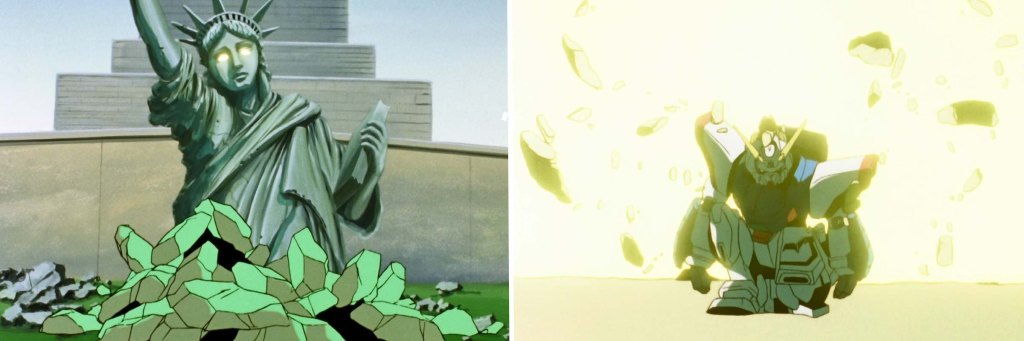
With older shows we did not have to think of these things since there was usually something like a research lab that functions as a base. However, for G Gundam, we could not set up a research lab. The Gundam Fighters had to travel on foot all over the world without a base, as there is no White Base! Then, I developed an “I don’t care” attitude, we weren’t thinking about it too much, so we wouldn’t let our audience think about it too much either. I just pushed the ideas based on the feeling, “It’s ok if it’s fun to watch!”
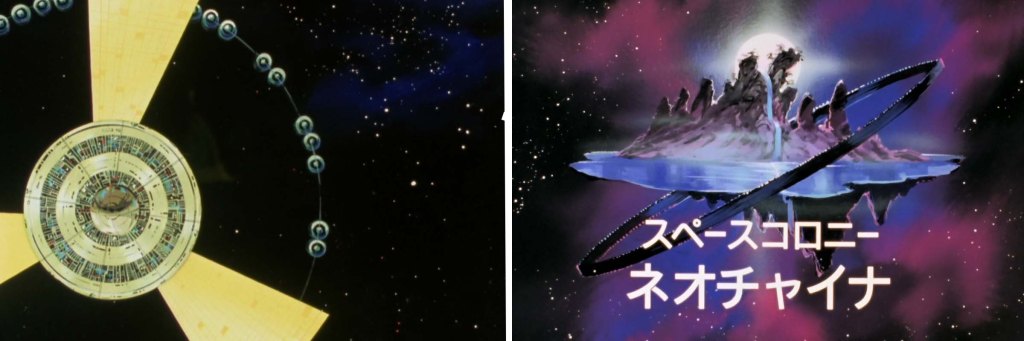
Q4: Why is Neo Japan’s transportation capsule flower shaped?
IMAGAWA: In the beginning, there were plans to create a cool Gundam and a beautiful Gundam. For a time, I was planning to take ideas from Thumbelina for the Gundam’s entrance scene, and it is the result of that idea that Shining Gundam comes out of a flower-shaped capsule. In fact, the idea came from Sachiko Kobayashi (laughs). I wanted to try something like “Oh, a Gundam is coming out of a flower blossom!!” It’s Sachiko Kobayashi it’s Kouhaku!!” (laughs) [Sachiko Kobayashi is a famous Japanese enka singer. Kouhaku is an abbreviation of “kouhaku-uta-gassen,” the annual Red vs. White Team-Singing Competition, which is broadcast in Japan at the end of each year. Sachiko Kobayashi always attends the competition as a singer, wearing a gorgeous flower costume.]
A while ago, there was a TV commercial for frozen udon noodles or something, in which, as a refrigerator gets opened, Sachiko Kobayashi comes out singing, “Because it’s frozen…” I loved this CM a lot. You know why? It’s because at that time I was working on Mister Ajikko and I got a strong impression that they made that CM after watching Mister Ajikko. In fact, I was already using that idea for Ajio-sama (“venerable Taste Emperor”), an old man authority character, who judges the cooking contests in Ajikko, and usually came out of a flower blossom. Thus, I was also taking the idea from Ajio’s image as well.
Q5: Was it challenging to depict all those country settings in the show’s first half?
IMAGAWA: When I heard that the heroes travel on foot all over the world to fight with each other, I thought I had to depict the world as realistically as possible. So, if the characters went to America, I wanted to depict something like America, and when in China, I wanted to show Chinese culture and atmosphere. In other words, I believed that how much national character we could include in the picture would be one of the most important parts of the setting design. Originally, I thought that sightseeing guidebooks would be good enough. Of course, there would be no way to do location hunting for each episode. It would have definitely been best if we could afford for it, though (laughs). However, the only problem that we encountered with referring to those guidebooks was that those books were trying to show landscapes and beautiful buildings, rather than showing something from the perspective of everyday people.
I believe a film needs to have such a perspective for an audience to believe in the film. So instead of location hunting, I thought of films. Film production of any sort always involves location hunting, so they can create a good setting. Besides, I think the perspective from a film camera has something very close to that of human eyes. If we could choose good images from films, I thought we could make settings from a fairly realistic point of view. So, I decided to refer to films. We didn’t just copy the images, we tried to recreate the feeling that we got from them. This wound up causing trouble later on though…
The image of Rome in episode one is from Federico Fellini’s Roma (1972). However, I had not watched it at the time. I was actually watching Ginger and Fred (1986) [also by Fellini]. This film depicts the city of Rome as a place strewn with garbage, it’s so messy. I thought the Rome suitable to the moral in episode one would be this kind of Rome. The reason why I like this film is that it dares to show the dirty portions of one’s own country, rather than trying to make it appear beautiful. It was a good reference for me in that it showed me how a messy portion of something can turn into a good picture. Also, I liked to watch “Powers of Evil” in Fellini’s Histoires Extraordinaires (1986). The image of Rome in this film is especially strong. It is a horror film, but Rome is a city of history, isn’t it. When I discussed it with Mr. Junichi Higashi, the background art director, he told me that each country should be treated as a character. Then, he suggested that Rome is a city of ghosts. So, we decided to go for it with the image that “a Gundam, a giant robot, is going to fight in a town of ghosts!”
During production of episode two, I was constantly telling the staff to draw a picture of a place they would easily think of as being America or New York. When I told them it could be anything that they know, they said the Brooklyn Bridge. As I thought of which film best depicted the Brooklyn Bridge, I decided on Woody Allen’s Manhattan (1979). I brought a video cover of this film to the studio and said, “Isn’t this good? Here, Domon will collapse, all right!?” We actually had never seen such a thing as the sunrise in New York, so we had to express something that we haven’t ever seen before. As Domon wakes up, he will see New York’s sunrise. But there is no way for us to depict something that we’ve never seen, after all. At least, we wanted to get the feel of it in terms of mise-en-scene. Then, we came to think why not experience America with Woody Allen’s film?
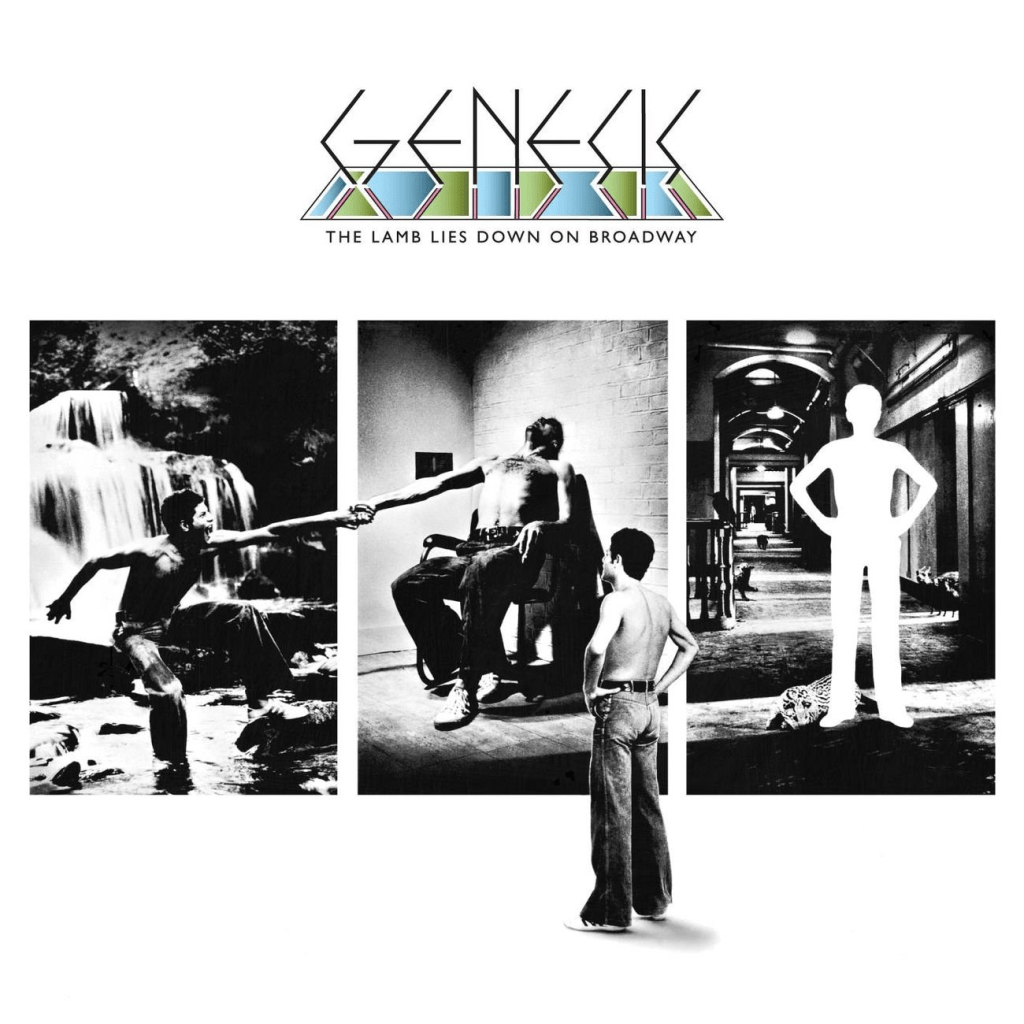
The reason why the Gundams fought on Broadway was that there was a Genesis CD titled The Lamb Lies on Broadway, and I was deeply impressed with the song’s lyrics. In the song, a person who has never been there suddenly feels the atmosphere and image of Broadway. So, we decided to make a picture from that lyric, Bunny standing alone there is the lamb. There is no meaning for the show at all, though. If asked what this meant, I would say that Bunny was standing alone in the morning mists as I tried to depict my own image of Broadway. This is my “The Lamb Lies on Broadway.” It is very interesting since a battle takes place in such a mysterious situation. So the fascination starts from there.
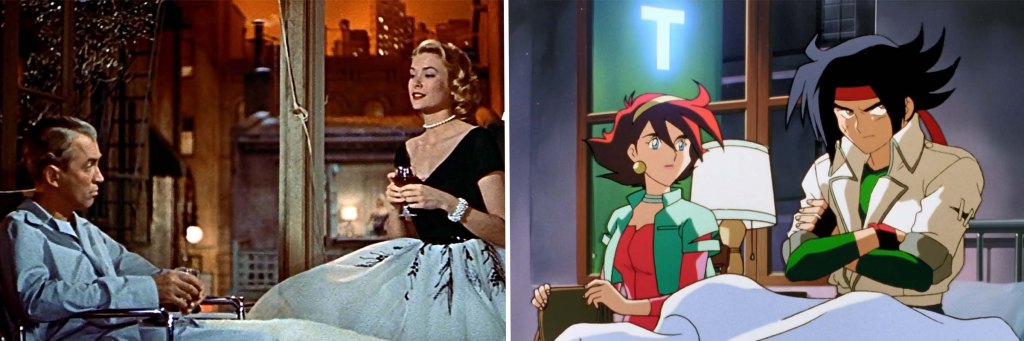
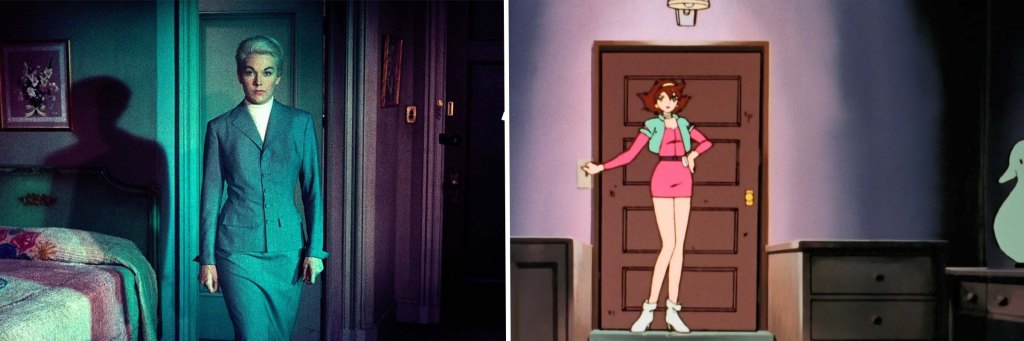
Also, in episode 2 there is a scene where Rain comes into Domon’s room. The idea for the hotel’s structure and the room is taken from the apartment in Alfred Hitchcock’s Rear Window (1954). I usually draw a square room if I have to depict a hotel room. If one is staying in a cheap hotel in downtown New York, the room should be a floor with 2 or 3 stairs in front way, rather than a neat-looking square room. It should be very different from a Japanese hotel room. I did not want a parody of Rear Window; I wanted to use the apartment since it has a very American feel. And when I thought about why I felt that way, I realized it was the stairs. Also, there was one scene in the film Vertigo (1958) where a woman opens a window and is back-lit by the hotel’s neon lights outside the window. I tried to make this cheap hotel feel more American by placing neon signs outside of the window. So, I rather enjoyed creating the settings for episode 2.
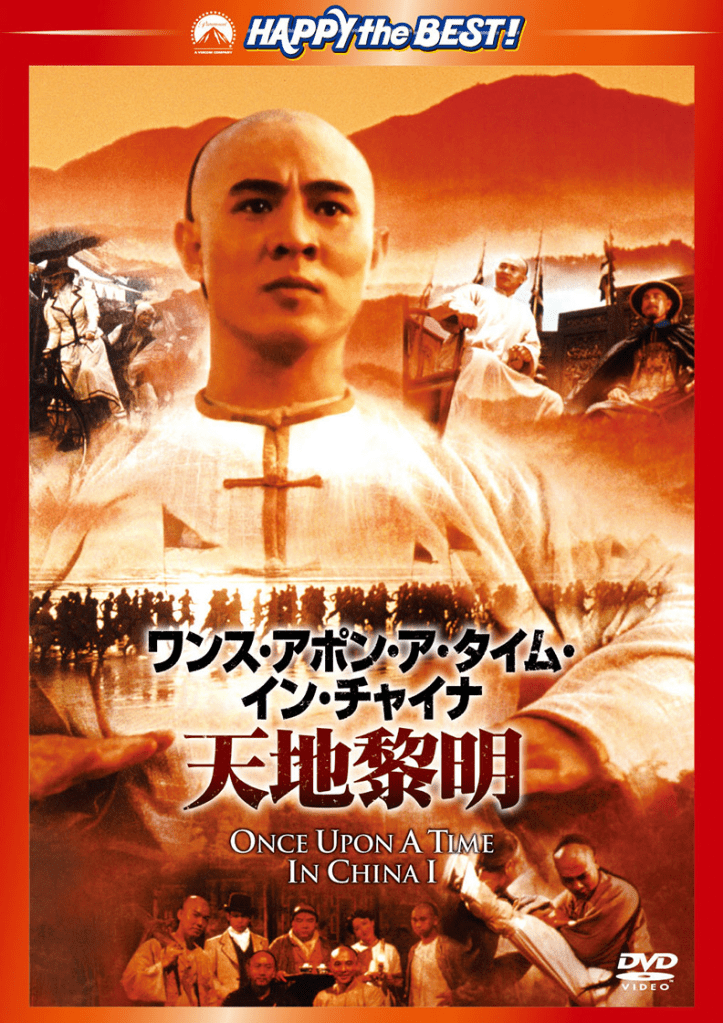
I loved the world of episode 3. Since China is full of peaceful and tranquil towns, it is not easy to draw. So, rather than specifying a location, I preferred to choose a place that I personally liked. The Hong Kong film series that never made it to Japan but is a personal favorite of mine is the Won Fei-Fong series. I also picked up some ideas from older films by director King Hoo, since I expected there would be more films that depicted the image of China more realistically than we would imagine. The settings are largely influenced by these films as well. The atmosphere in the town was borrowed from the Wong Fei-hung series, and it becomes a world of traditional Chinese landscape painting as the location shifts to the countryside in the latter half of the episode. There are tall mountains, waterfalls, and pine trees. I said it would be perfect to have this three-piece set (laughs). Also, I remember that I was paying special attention to small items in town scenes. This episode was a good experience for us to learn that, even though these little details appear insignificant, they would make a huge difference. I suppose especially Mr. Higashi was having difficulties at the time, but he made really excellent setting designs for the town so I approved them with one blow, saying “Oh, you got me!”
The country for episode 4 was France. However, French cinemas were fairly difficult to transfer to anime, so I used the images in Swing Out Sisters’ early video clips, with the concept that the two walk around in the city of Paris. The video clip showed something of Paris that I have never seen in other countries. It provided good references for things like hand railings and neatly aligned staircases. We also had a reference for the place where Maria Louise was tied to a tree. There should be a restaurant with a terrace on a hill, and this restaurant is designed so people can eat and enjoy the view. I wanted the restaurant to look old and rather worn. Well, I wished to create the atmosphere of the stores on Aoyama Avenue in Japan. I believe it was difficult for us because France is a country which was originally clean and beautiful but eventually became aged and frayed.
[DISC ONE END]
 Ker's Ramblings